.svg)
Expanding Overseas? Here's How to Handle Payments
Written by
.svg)
Expanding overseas? Learn how to handle international payments, currency support, and processing fees when scaling a business abroad.
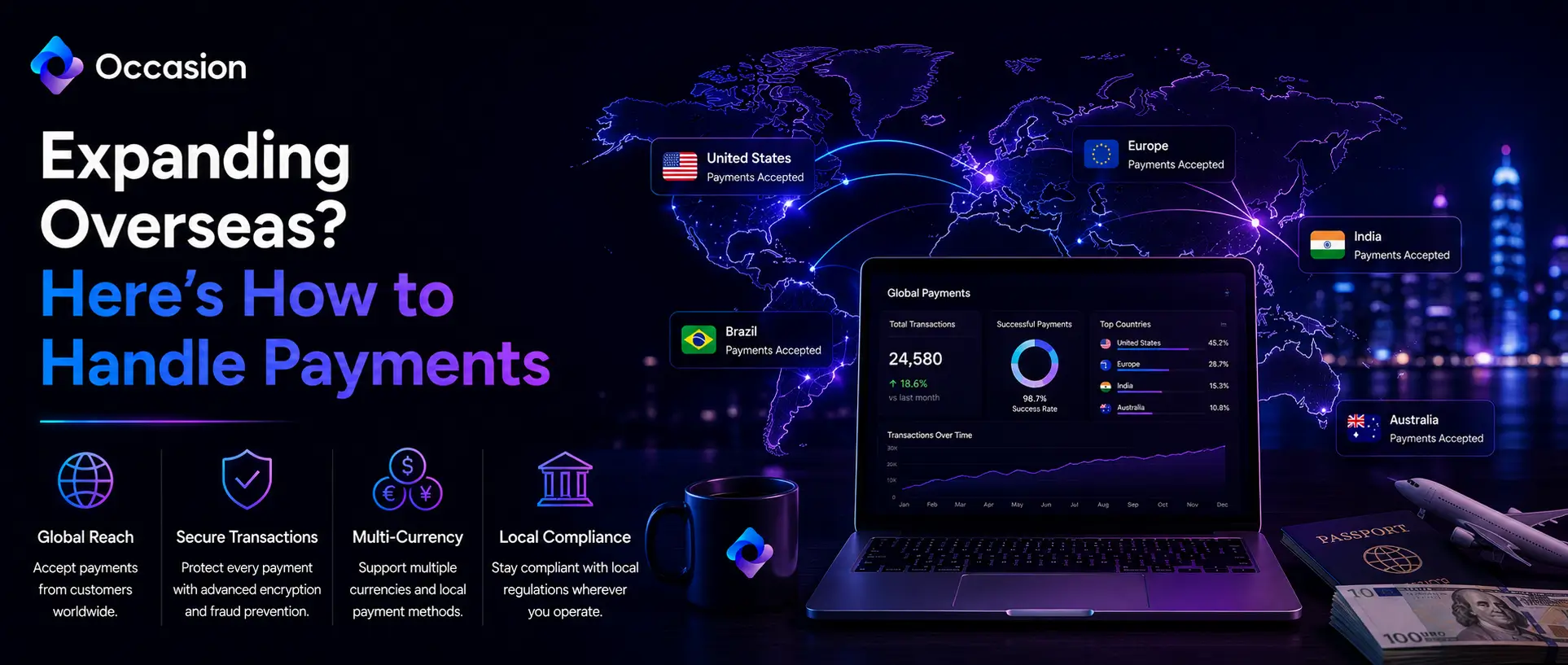
Learning how to handle international payments becomes one of the first real challenges once a business starts booking customers outside its home country. Currency conversion, processing fees, and local payment preferences all shift the moment a business crosses a border, and getting this wrong can cost real revenue.
Occasion supports sellers worldwide, letting businesses charge customers in their local currency no matter where they are based. Built by a team across the U.S., Spain, Poland, South Africa, and the Netherlands, Occasion has processed 3.5 million bookings and generated over $ 300 million in seller revenue across more than 8,000 sellers worldwide.
What Changes When a Business Starts Accepting International Payments
Accepting payments overseas means dealing with currency conversion, varying processing rates, and customers who expect pricing in their own currency. A business that only accepts one currency risks confusing or losing customers who see unfamiliar exchange rates at checkout instead of clear local pricing. Setting up a system early to handle international payments correctly saves a lot of cleanups later.
How Multi-Currency Support Simplifies Overseas Sales
Multi-currency support lets a business display and charge prices directly in a customer's local currency without manual conversion. This removes a major point of friction at checkout, since customers see exactly what they are paying without doing mental math on exchange rates.
What Currency Options Businesses Need When Expanding Abroad
- Support for charging customers in their own local currency.
- Integration with widely trusted processors like Square and Stripe.
- Lower processing rates through Apple Pay and Google Pay options.
- Automated reminders that reduce no-shows on international bookings.
Businesses that want to Accept Payments Seamlessly across borders need tools built for global reach from the start, rather than bolting on international support later. That foundation makes scaling into new countries far less complicated.
Why Processing Fees Matter More Overseas
Occasion keeps booking fees 75 percent lower than the average offered by other providers, which matters even more once you add international transaction costs to the equation. Businesses can absorb this fee or pass it on, and 63 percent of merchants choose to pass it directly to customers.
Which Payment Tools Work Best for Global Customers
Square and Stripe remain the most reliable payment gateways for businesses expanding overseas, with Square offering the smoothest experience where available. Combining these tools with automated reminders and pre-payment options helps reduce no-shows across different time zones and cultures.
Occasion continues supporting sellers in any country, though translation currently covers only English and Spanish for the platform itself. That global reach, paired with local currency support, makes expanding overseas feel far less overwhelming for growing businesses.
Conclusion
Expanding overseas requires the right payment tools to handle currency and processing smoothly. Occasion helps businesses accept payments confidently from customers worldwide.
Keep reading


Occasion’s mission is to empower those who build happier communities.